Buying a Home in Toronto and the GTA: A Practical Buyer’s Guide
By Marco Momeni, Broker, RE/MAX Hallmark Realty
Updated: August 9, 2026
Buying a home in Toronto or the GTA usually starts with listings, but the most important decisions happen before you choose a property.
You need to know what you can comfortably afford, how much cash you will actually need to close, which locations and property types fit your plans, and what risks you are prepared to accept when you make an offer.
Toronto and the GTA are also not one uniform housing market. A downtown Toronto condo, a detached home in Richmond Hill, a semi in North York or a townhouse in Markham can involve very different costs, competition, maintenance responsibilities and resale considerations.
After 24 years working with buyers and sellers across Toronto and the GTA, I find that the strongest purchases usually start with a clear plan rather than a particular listing.
Here are the seven questions I believe buyers should answer before committing to a property.
1. How much money do I need to buy a home in Toronto or the GTA?
The amount you need is more than your down payment. A realistic purchase budget should include your down payment, deposit, land transfer taxes, legal and closing expenses, adjustments and enough money left over after closing for the unexpected.
How much down payment do you need?
For homes priced below $1.5 million that qualify for insured financing, the current minimum down payment is:
- 5% of the first $500,000; plus
- 10% of the portion above $500,000.
For homes priced at $1.5 million or more, CMHC mortgage insurance is not available and a minimum 20% down payment is required under the applicable insured-mortgage rules. CMHC confirms the current thresholds and down-payment structure.
For example:
| Purchase price | Minimum down payment* |
|---|---|
| $500,000 | $25,000 |
| $750,000 | $50,000 |
| $1,000,000 | $75,000 |
| $1,250,000 | $100,000 |
| $1,499,000 | $124,900 |
*These examples show the mathematical minimum under the applicable insured-financing rules. They do not mean every borrower or every property will qualify.
For purchases eligible for insured financing, a down payment of less than 20% will generally require mortgage default insurance. That insurance protects the lender against borrower default; it is not insurance protecting the buyer from an inability to make mortgage payments.
Your deposit and your down payment are not the same thing
This distinction causes confusion for many buyers.
The deposit is the money provided in connection with your Agreement of Purchase and Sale. Assuming the transaction closes, it forms part of the money credited toward the purchase price.
The down payment is the total amount of your own equity going into the purchase.
The practical issue is timing. You may ultimately have enough money for the down payment but still need access to a substantial deposit quickly after an offer is accepted.
Before making offers, know:
- how much cash you can access immediately;
- where your down-payment funds are coming from;
- whether any funds need to be transferred or liquidated;
- and how much you want to keep available for closing costs and reserves.
First-time buyers may have additional options
Eligible first-time buyers may be able to use a First Home Savings Account (FHSA). CRA confirms that FHSA participation room starts at $8,000 in the first year an account is opened, subject to the program rules, with a $40,000 lifetime contribution limit. Contributions are generally deductible, and qualifying withdrawals toward an eligible first home can be tax-free.
The federal Home Buyers’ Plan (HBP) can also allow an eligible buyer to withdraw up to $60,000 from an RRSP toward a qualifying home. CRA confirms that, where all requirements are met, the HBP and FHSA can be used for the same qualifying home.
These programs can help you assemble the funds for a purchase. They do not, however, answer the more important question: how much should you actually spend?
I would not automatically use the maximum price a lender says you can qualify for.
Your housing budget also has to leave room for property taxes, utilities, condo fees where applicable, insurance, maintenance, transportation, family expenses and unexpected costs.
The goal is not simply to have enough money to close. You should still be financially comfortable after you get the keys.
2. What closing costs should I budget for when buying in Toronto or elsewhere in the GTA?
Your down payment is only one part of the cash required to purchase a home. Land transfer tax is usually one of the largest additional expenses, and there is an important difference between buying inside the City of Toronto and buying elsewhere in the GTA.
Ontario Land Transfer Tax
A buyer purchasing real estate in Ontario is generally subject to Ontario Land Transfer Tax, calculated using progressive tax brackets.
Eligible first-time homebuyers may qualify for an Ontario Land Transfer Tax refund of up to $4,000, subject to the Province's eligibility requirements.
Buying in the City of Toronto costs more in land transfer tax
If the property is located within the City of Toronto, the buyer can also be subject to the Toronto Municipal Land Transfer Tax, in addition to Ontario's Land Transfer Tax.
This means that two homes with the same purchase price — one within Toronto and one elsewhere in the GTA — can require substantially different amounts of cash on closing.
Toronto also revised its graduated Municipal Land Transfer Tax rates for higher-value residential properties effective April 1, 2026. The City's current residential structure starts at 0.5% on the lowest bracket and now includes additional graduated rates above $3 million.
Eligible first-time purchasers may qualify for a Toronto MLTT rebate of up to $4,475.
Calculate it before you decide how much cash you have available
You can use my Land Transfer Tax Calculator to estimate the Ontario Land Transfer Tax and, for a property within Toronto, the applicable Toronto Municipal Land Transfer Tax.
Use the calculator as a planning tool rather than as the final closing statement. Your lawyer should confirm the actual tax payable and your eligibility for any refund or rebate based on your transaction.
What other closing expenses should you expect?
Depending on the property and transaction, you should also plan for items such as:
- lawyer's fees and disbursements;
- title insurance;
- lender appraisal costs, where required;
- a home inspection;
- condominium-document costs where applicable;
- adjustments for property taxes or condominium common expenses;
- homeowner insurance;
- moving expenses;
- immediate repairs or improvements.
The numbers vary too much from one transaction to another for me to recommend a generic percentage and pretend it applies to everyone.
A more useful approach is to calculate the known expenses for the actual property and then leave a reasonable reserve.
One question I often want a buyer to answer is:
How much cash will you still have the day after closing?
That number matters.
A note on taxes and rebates: Eligibility and amounts can depend on the purchaser, property and transaction. Your real estate lawyer, accountant or tax professional should confirm the treatment that applies to your circumstances.
3. How do mortgage pre-approval and the mortgage stress test determine what I can actually afford?
A mortgage pre-approval is an important starting point, but it is not the same as final mortgage approval and it should not automatically become your spending target.
There are two separate decisions here: what a lender may finance and what you can comfortably afford.
How the mortgage stress test works
For uninsured mortgages at federally regulated lenders, OSFI's current minimum qualifying rate is the greater of:
- your mortgage contract rate plus 2 percentage points; or
- 5.25%.
OSFI confirmed this standard in its January 2026 update.
The stress test means you may have to demonstrate that you can carry the mortgage at a rate higher than the one you will initially pay.
Why a pre-approval is not a guarantee
A pre-approval largely evaluates you as a borrower. Once you purchase a specific property, the lender may still have to review the actual transaction.
Depending on the situation, that can include:
- the Agreement of Purchase and Sale;
- the property appraisal;
- the type and condition of the property;
- condominium information;
- your income documentation;
- your credit and debts;
- the source of your down payment;
- and lender-specific underwriting requirements.
Your financial circumstances can also change between pre-approval and purchase.
This is why I do not tell a buyer, “You're pre-approved, so financing is no longer an issue.”
Qualification and affordability are different
Suppose a lender is prepared to finance a certain purchase price. That tells you something important, but it does not tell you whether spending that amount is the best decision for your household.
I normally want buyers to look at the monthly cost of ownership as a whole:
- mortgage payments;
- property taxes;
- utilities;
- condo fees where applicable;
- insurance;
- maintenance;
- transportation;
- existing debts;
- and normal family expenses.
Then we can work backward toward a comfortable purchase price.
A buyer who qualifies for $1.2 million does not have to buy for $1.2 million.
Estimate your buying power before you seriously start shopping
You can use my Mortgage Affordability Calculator as a starting point to estimate your potential buying range.
The result is an estimate, not a mortgage approval. Individual circumstances can make a significant difference. Income structure, credit, debts, down payment, property type, existing assets and lender programs may result in your actual qualification being higher or lower than a basic calculator suggests.
This becomes particularly important for buyers who are self-employed, have multiple income sources, substantial assets, investment properties or other circumstances that do not fit neatly into a basic calculator.
If you are unsure what your real buying range is, contact me at 416.700.7070. We can look at the real estate side of the decision and, where appropriate, coordinate with a qualified mortgage professional to determine what financing options may actually be available to you.
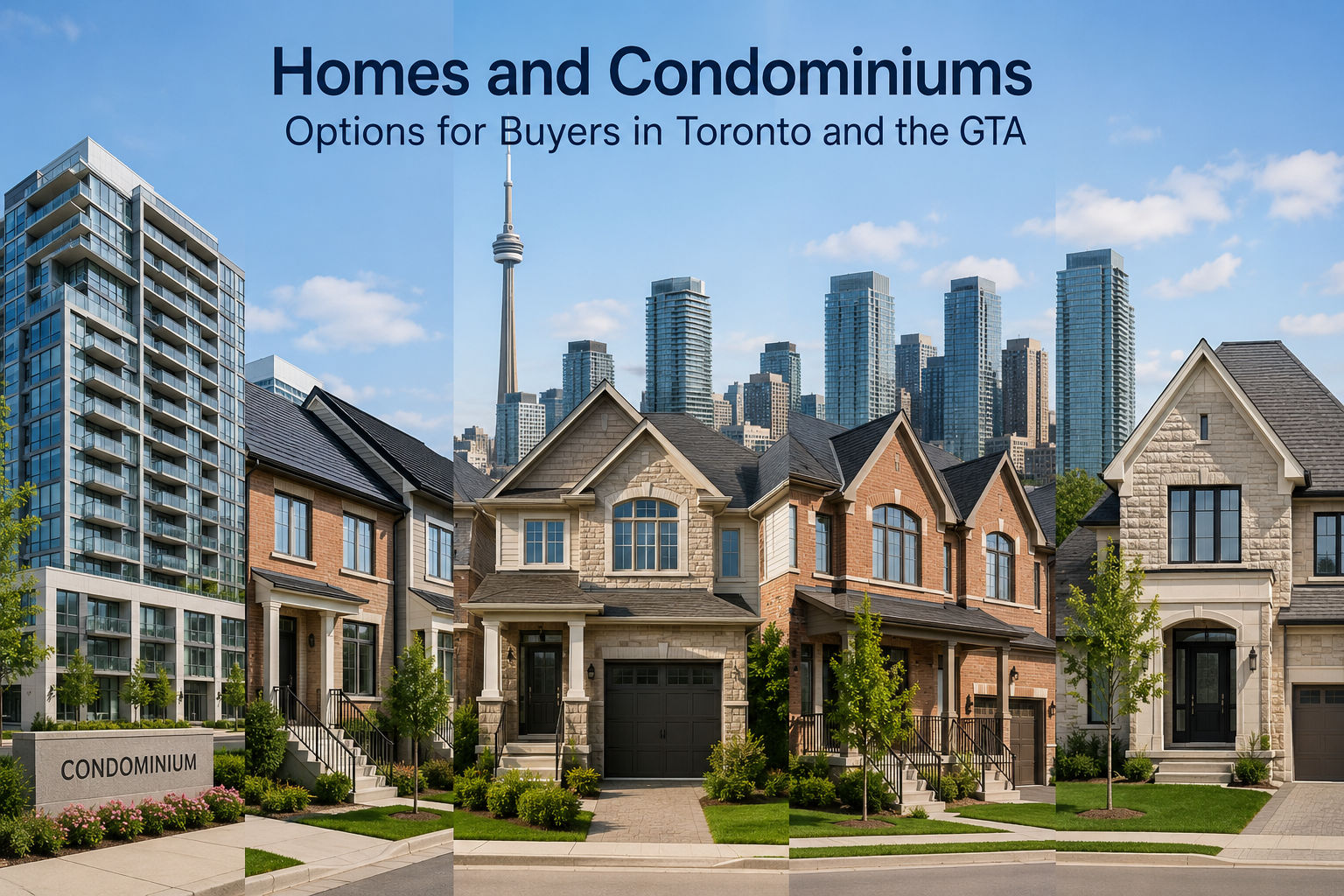
4. Should I buy a condo, townhouse, semi-detached or detached home in the GTA?
The right property type depends on the trade-off you are prepared to make between location, space, carrying costs, maintenance and how long the home is likely to serve your needs.
There is no property type that is automatically the best investment or the best home.
In the GTA, buyers are often trading one advantage for another.
Moving farther from Toronto may give you more space or a detached home. Staying closer to work, transit or a particular neighbourhood may mean choosing a townhouse, semi or condo instead.
The useful question is not, “Which property type is best?”
It is, “Which set of compromises works best for me?”
Condo apartment
A condo can make sense if location, convenience and lower exterior-maintenance responsibility are priorities.
But you are buying more than the unit.
You are also buying into a condominium corporation, which means its finances, reserve fund, common expenses, rules, major repairs and potential special assessments matter.
The Condominium Authority of Ontario confirms that a status certificate can contain the corporation's governing documents, budget, audited financial statements, information about the reserve fund, common expenses and increases, among other important information.
That is why two similar-looking units in two neighbouring buildings can be very different purchases.
Condo townhouse
A condominium townhouse can sometimes provide substantially more living space than a condo apartment while keeping some exterior maintenance under the condominium corporation.
But do not assume every townhouse works the same way.
You need to understand what the corporation maintains, what you maintain, how much the fees are and what those fees actually cover.
Freehold townhouse
A freehold townhouse generally gives the owner greater independence from a condominium corporation, but it also means taking on the home's maintenance directly.
Parking, lot width, layout, shared walls, natural light and basement configuration can all influence both how the property functions today and how easy it may be to resell later.
Semi-detached home
A semi can be a very good compromise in parts of Toronto where fully detached properties command a significant premium.
Depending on the property, I pay attention to the shared wall, sound transfer, additions and alterations, parking, lot characteristics and how the two sides of the structure have been maintained over time.
Detached home
A detached home generally provides the greatest physical independence and often more land.
But the word “detached” should never substitute for proper analysis.
A good semi on a strong street can be a better purchase than a detached house with a poor layout, compromised lot, difficult location or major deferred maintenance.
The same applies to size.
More square footage is useful only if you want and can comfortably maintain it.
Think 5 to 10 years ahead
Before choosing the property type, consider what may change.
Will you need another bedroom?
Could elderly parents eventually live with you?
Is a long commute acceptable?
Is private outdoor space important?
Would stairs become an issue?
Do you want to renovate?
Would you rather maintain the house yourself or pay condo fees for some of that responsibility?
A property does not have to meet every possible future need. But if there is a good chance you will outgrow it very quickly, that should be part of the decision before you buy.
5. How should I choose the right Toronto or GTA neighbourhood before buying?
Whenever possible, choose the location before you fall in love with an individual property.
A kitchen can be renovated. Flooring can be replaced. The street, commute, neighbouring land uses and municipality cannot be moved.
Here is what I would investigate.
Commute and transportation
Do not judge a commute only from a map.
If travelling to work is important, test the route at approximately the time you will actually travel.
Depending on the location, consider:
- highway access;
- GO Transit;
- TTC or municipal transit;
- travel time during rush hour;
- walking and cycling;
- planned transportation projects;
- and how often you actually need to commute.
A larger house can lose some of its appeal if you spend an extra two hours every day getting to and from it.
Schools
If school eligibility matters to your purchase, verify it for the exact address.
Do not assume a property belongs to a school simply because the school is nearby or because a real estate listing refers to it.
Attendance boundaries, programs and eligibility can change. Buyers should confirm the applicable public or Catholic school directly with the relevant school board before relying on it for a purchase decision.
We will address Toronto and York Region schools in dedicated guides because the subject deserves address-level verification rather than broad statements such as “this is a good school neighbourhood.”
The type of housing available
Neighbourhoods at similar price points can offer completely different housing.
One area may have newer homes on smaller lots. Another may have older homes on larger lots but require more renovation and maintenance.
Some neighbourhoods are dominated by condos and townhouses. Others have few entry-level housing options.
Understanding the local housing stock helps you decide whether your expectations and your budget actually belong in the same neighbourhood.
What daily life will really look like
A neighbourhood should be evaluated as somewhere you are going to live, not somewhere you are visiting for a 20-minute showing.
Depending on your priorities, look at:
- grocery shopping;
- parks and recreation;
- restaurants;
- places of worship;
- healthcare;
- children's activities;
- walkability;
- traffic;
- noise;
- access to family and friends.
These are not small details once you live there every day.
What is likely to change around the property?
Future development can improve a neighbourhood, but it can also change it.
New transit, retail or residential projects can bring amenities and accessibility. They can also bring construction, traffic, density or changes to an existing view.
When something significant near a property appears likely to change, investigate it before assuming today's surroundings will remain exactly the same.
Think about the next buyer too
You are buying a home for yourself, but eventually somebody else may have to want it.
A property does not need to appeal to everyone. But when it has several unusual compromises — difficult parking, a very unusual layout, significant traffic, poor natural light or unusually high carrying costs, for example — its future buyer pool may be smaller.
There is nothing wrong with accepting a compromise that works for you.
The mistake is paying as if the compromise does not exist.
6. What should I investigate before making an offer on a Toronto or GTA property?
Before making an offer, you should investigate both the property's value and the property itself.
The asking price is a marketing decision. It is not proof of value.
Start with relevant comparable sales
A home may be listed:
- close to expected market value;
- intentionally below expected value to attract multiple offers;
- or above what recent comparable evidence supports.
I therefore prefer to analyze relevant recent sales before deciding what a buyer should offer.
A useful comparison can include differences in:
- location;
- property type;
- lot;
- size and layout;
- condition;
- renovations;
- parking;
- basement;
- exposure or view;
- and condominium characteristics where applicable.
The closest sale geographically is not automatically the best comparable.
The objective is to understand what informed buyers have recently paid for properties that compete with the one you are considering.
Look beyond the finishes
A beautifully staged home can still have expensive problems.
For a freehold property, the physical investigation can include areas such as:
- roof;
- foundation;
- grading and drainage;
- evidence of water penetration;
- electrical system;
- plumbing;
- heating and cooling systems;
- windows;
- insulation;
- additions or structural changes;
- retaining walls;
- decks;
- and other major components.
RECO recommends that buyers consider a qualified home inspection and notes that inspections can assess major systems such as electrical, roofing, plumbing, heating and cooling and the foundation.
My civil engineering background naturally makes me pay attention to more than finishes when I walk through a property — grading, water management, alterations, structural clues and how the building appears to have been maintained.
That does not replace a qualified home inspector, engineer or other specialist when one is required. If something raises a technical concern, the appropriate professional should investigate it.
A renovated home still requires due diligence
“Fully renovated” is not the end of the investigation.
Sometimes it is the beginning.
Depending on the work completed, useful questions can include:
- What was changed?
- Was structural work involved?
- Were permits required?
- Is documentation available?
- Were electrical, plumbing or mechanical systems updated?
- Or was the renovation mainly cosmetic?
Good finishes add value. They should not distract you from what is behind them.
Condo buyers need to investigate the corporation as well as the unit
With a resale condominium, the physical unit is only part of what you are purchasing.
The status certificate can provide important information regarding the condominium corporation's finances, reserve fund, common expenses, governing documents and other matters. The Condominium Authority of Ontario specifically identifies reserve-fund and special-assessment information as important to buyers.
Your lawyer should review the status certificate and advise you on its legal implications.
We will cover this much more deeply in the dedicated Toronto condo-buying guide, but the basic rule is simple:
Never evaluate a condominium only by looking inside the unit.
7. What conditions should I include in an offer, and when is a firm offer too risky?
The right conditions depend on the buyer, the property and the risks that still need to be resolved.
There is no one offer structure that makes sense for every transaction.
RECO's buyer guidance specifically identifies conditions such as mortgage financing, a home inspection and the sale of an existing property as potential protections buyers may consider.
Financing condition
A financing condition can give the buyer time to obtain satisfactory financing for the specific purchase.
This can still matter when you have already been pre-approved.
The lender may assess the actual property, appraisal and transaction after you have an accepted offer. If the property appraises below the purchase price or the lender has an issue with the property or financing, the result may be different from the initial pre-approval.
Before removing a financing condition, understand what happens if your lender does not provide the mortgage you expect.
Home-inspection condition
A home-inspection condition can give you an opportunity to investigate the property's physical condition before becoming fully committed.
In a competitive market, buyers are sometimes tempted to remove this condition to strengthen their offer.
RECO specifically cautions that foregoing a home inspection in a competing-offer situation can expose buyers to defects, repairs or upgrades they did not know about and describes this as a significant risk that should be carefully considered.
In some cases, a seller may provide a pre-list inspection. That can be useful information, but whether a buyer should rely on it should be considered case by case.
Status-certificate condition for a condo
For a resale condominium, legal review of the status certificate can be extremely important.
The document can reveal information about the corporation that you cannot discover during a showing: finances, reserve-fund information, increases in common expenses, legal matters and other issues.
Sale-of-property condition
A buyer who needs to sell an existing home before completing the next purchase may consider making the offer conditional on that sale.
Whether a seller is prepared to accept the condition depends on the property, competition and market conditions.
If you are both buying and selling, the sequence deserves careful planning because financing, deposits, bridge financing, closing dates and contingency plans can become just as important as the negotiated price.
Is a firm offer always a bad idea?
No.
A firm offer can be entirely appropriate in the right circumstances.
The risk comes when someone removes protections without understanding what could happen if something goes wrong.
Before submitting a firm offer, I would want the buyer to understand the answers to questions such as:
- Is financing sufficiently secure?
- What happens if the appraisal is lower than the purchase price?
- Has the property been adequately investigated?
- If it is a condo, has the necessary documentation been reviewed?
- Is there enough cash available to complete the transaction?
- Are there unresolved legal or property issues?
- Can the buyer financially absorb the consequences if an assumption turns out to be wrong?
Competition can affect offer strategy, but it should not cause you to accept a risk you do not understand.
RECO also notes that Ontario buyers who have submitted an offer are entitled to know the number of competing offers, while the seller controls whether the content of competing offers is shared in accordance with Ontario's open-offer rules.
Sometimes a firm offer is justified.
Sometimes keeping a condition is more important than making the strongest-looking offer.
And sometimes the right decision is to let that property go.
What does a good Toronto or GTA home-buying process look like?
For most resale buyers, I prefer the process to happen roughly in this order:
1. Establish a comfortable budget.
Determine what you can afford, not simply the maximum amount you can borrow.
2. Organize financing before serious shopping.
Understand your qualification, available down payment and closing-cost requirements.
3. Decide which property types actually fit your plans.
4. Narrow the municipalities and neighbourhoods.
5. See enough properties to understand what your budget buys.
6. Investigate the individual property before becoming emotionally committed to it.
7. Analyze comparable sales and determine what the property is worth to you.
8. Decide which conditions and protections are appropriate.
9. Complete the required financing, inspection, legal and other due diligence.
10. Prepare properly for closing.
That sequence is not complicated, but buyers sometimes reverse it.
They see a house, become emotionally attached to it and then start trying to make the financing, location and risks fit the property.
I would rather establish the important decisions first.
What are the biggest mistakes buyers should avoid?
In my experience, expensive mistakes usually do not happen because buyers could not find enough listings.
They happen when a buyer makes one of three mistakes.
Buying the wrong property
The home may look attractive today but not fit the buyer's actual lifestyle, commute, family plans or likely needs over the next several years.
Paying the wrong price
The buyer becomes focused on the asking price or competition rather than the evidence supporting the property's value.
Accepting a risk they do not understand
A condition is removed, an issue is overlooked or an assumption is made simply because the buyer is afraid of losing the property.
That is why I don't think the goal of an offer should be to “win the house.”
The objective is to complete a purchase that still looks like a good decision after the excitement of the offer is gone.
Planning to buy a home in Toronto or the GTA?
Buying successfully is not simply about having access to listings. Buyers can see almost every property online today.
The value comes from knowing which property makes sense, what it is worth, what should be investigated and how much risk is reasonable to take to secure it.
If you are trying to determine what you can afford, where to focus your search or whether a particular Toronto or GTA property makes sense for you, contact Marco Momeni at 416.700.7070.
About Marco Momeni
Marco Momeni is a Broker with RE/MAX Hallmark Realty serving Toronto and the Greater Toronto Area.
With 24 years of real estate experience and more than $1 billion in career sales, Marco works with home buyers, move-up buyers, luxury-property clients, condominium purchasers and real estate investors across Toronto and the GTA.
His background in civil engineering contributes to a practical, analytical approach to evaluating property, value, location and risk.
Marco Momeni
Broker, RE/MAX Hallmark Realty
416.700.7070
MarcoMomeni.com