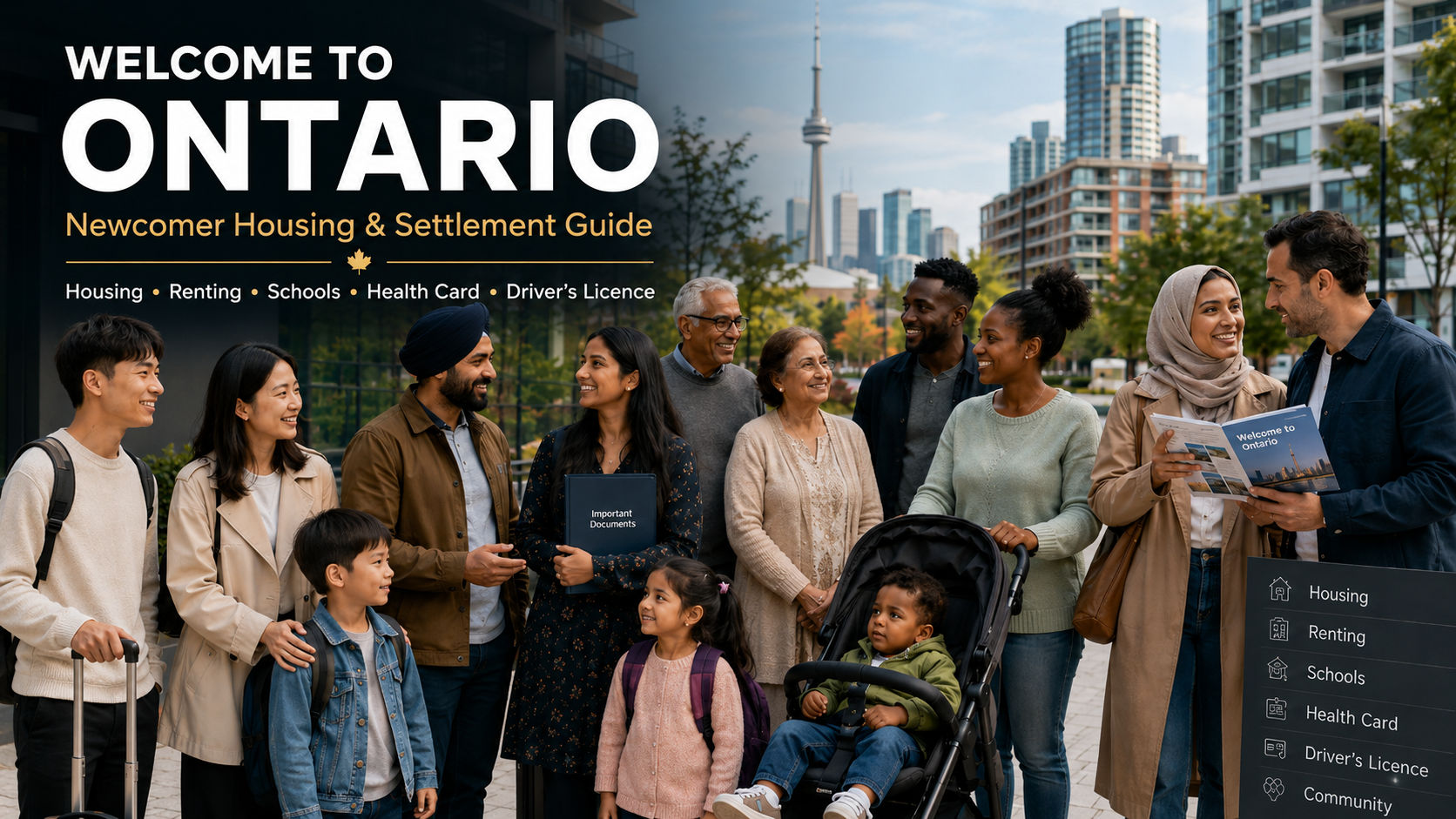
Newcomer Guide to Toronto & Ontario: Housing, Renting, Schools, Health Cards, Driver’s Licences and More
By Marco Momeni, Broker, RE/MAX Hallmark Realty.
If you are new to Toronto or Ontario, housing is only one part of settling in.
Very quickly, you may also need to arrange a residential address, rent a home without Canadian credit, register children for school, apply for a health card and SIN, understand Ontario driver’s licensing, open a bank account and begin building Canadian credit.
This guide brings those practical questions together in one place.
It is intended for newcomers settling in Toronto and the Greater Toronto Area , including permanent residents, work-permit holders and other people establishing themselves in Ontario. Eligibility for government programs varies by immigration status, so use the official links below to confirm your own situation.
Quick Start: What should I arrange first after arriving in Ontario?
For most newcomers, the first priorities are:
-
Arrange reliable temporary or permanent accommodation.
-
Establish a usable residential address.
-
Apply for a Social Insurance Number if you are eligible and need one for work.
-
Determine whether you qualify for OHIP and apply for a health card.
-
Start the Ontario driver’s-licence process if you plan to drive.
-
Open a Canadian bank account.
-
Register school-age children using the required proof of address.
-
Investigate free language and newcomer settlement services if eligible.
-
Begin building Canadian credit.
-
Do not rush into a long-term lease or home purchase until you understand your commute, neighbourhood and realistic budget.
The order may differ depending on your immigration status, employment and family situation.
1. Where should I stay when I first arrive in Toronto?
For many newcomers, temporary accommodation for the first few weeks is more practical than immediately committing to a one-year lease or purchasing a property.
If you have not yet confirmed your job location, commute, school requirements or preferred community, temporary accommodation gives you time to understand how your life in the GTA will actually work.
Short-term accommodation
Hotels and legal short-term rentals such as Airbnb can work for an initial stay.
In Toronto, a short-term rental generally means accommodation rented for less than 28 consecutive days , and the City regulates short-term rentals. ( Canada )
City of Toronto short-term rental information:
Furnished or extended-stay accommodation
If you expect to need accommodation for several weeks or months, a furnished suite may be more practical than repeatedly extending a hotel stay.
Current examples include:
DelSuites — Downtown Toronto and other GTA locations
DelSuites currently requires a 30-night minimum stay at its locations. ( DelSuites )
Sloane — Yorkdale / North York
Sloane is a purpose-built rental community across from Yorkdale Shopping Centre. Its current rental application process includes proof of employment or funding and government-issued identification. ( Sloane Yorkdale )
Liberty Suites — Yonge and Steeles / Thornhill
These are examples rather than endorsements. Confirm current pricing, minimum stays, availability and application requirements directly with the accommodation provider.
What should I do during a temporary stay?
Use the time to test real life rather than simply look at properties online.
Try your actual commute.
Drive or take transit during rush hour.
Visit the grocery stores and services you would regularly use.
Check how long it takes to reach family members.
Walk the neighbourhood during the day and evening.
If you have children, investigate school-registration requirements before committing to the address.
A few weeks of observation can prevent a much more expensive location mistake later.
2. How can I rent a home if I have no Canadian credit history?
You can rent a home without an established Canadian credit file, but your application may require stronger alternative documentation.
Canadian credit history is often used by landlords when assessing rental applications, and limited credit history can make renting more difficult. ( Canada )
A newcomer may have excellent finances but no Canadian record yet.
Depending on the landlord and property, useful supporting documents may include:
-
employment letter or employment contract;
-
proof of income;
-
bank statements;
-
evidence of accessible savings;
-
previous landlord references;
-
international credit documentation where accepted;
-
and a financially qualified guarantor.
There is no single formula that every landlord must accept.
Can a guarantor help?
Yes. A financially qualified guarantor may strengthen an application when the applicant does not yet have enough Canadian credit or employment history.
A guarantor can become legally responsible for obligations covered by the guarantee if the tenant does not perform them.
Read the guarantee carefully before signing it.
3. Can a landlord ask me to pay six or twelve months of rent in advance?
A landlord generally cannot require an excessive rent deposit simply because you are new to Canada.
Ontario’s standard lease guidance states that the landlord may generally collect a rent deposit for the last rental period, and that the deposit cannot exceed one month’s rent for a monthly tenancy. ( Ontario )
Official Ontario information:
https://www.ontario.ca/page/guide-ontarios-standard-lease
Ontario Residential Tenancies Act:
https://www.ontario.ca/laws/statute/06r17
In the real rental market, some newcomers consider voluntarily offering additional rent in advance because they have no Canadian credit or employment history.
That situation should not be confused with a landlord improperly demanding an unlawful deposit.
If a large advance payment is being proposed, obtain independent legal advice before agreeing to it.
Do not assume that something is legal or advisable simply because another tenant has done it.
4. What type of lease should I sign in Ontario?
Most residential tenancies covered by Ontario’s Residential Tenancies Act use Ontario’s standard form of lease.
The standard lease addresses matters such as:
-
rent;
-
utilities;
-
deposits;
-
parking;
-
smoking;
-
tenant insurance;
-
maintenance;
-
and landlord and tenant responsibilities. ( Ontario )
Official Ontario guide:
https://www.ontario.ca/page/guide-ontarios-standard-lease
Do not assume that every extra condition written into a lease is automatically enforceable.
If an important term is unclear or unusual, obtain independent legal advice before signing.
5. Should a newcomer rent first or buy immediately?
If your employment location, commute, school needs or long-term plans are still uncertain, renting first can be the safer decision.
Buying immediately may make sense when your employment, financing and location are already clear.
But purchasing before you understand the GTA can lock you into the wrong location.
Before buying, answer these questions:
-
Where will I work?
-
How frequently will I commute?
-
Do I need subway access?
-
Will I need one car or two?
-
Which school board or schools matter?
-
Do I expect relatives to live with me?
-
How much space do I actually need?
-
What is my total monthly housing budget?
-
How long do I expect to remain in the property?
For a broader comparison of Toronto and GTA locations, see:
Moving to Toronto or the GTA
For an initial estimate of home-buying affordability:
https://www.marcomomeni.com/mortgage-affordability-calculator
The calculator provides general estimates only. Individual circumstances vary, and some buyers may qualify for more or less than the estimate. A qualified mortgage professional should confirm actual financing before you rely on a purchase budget.
6. Can a newcomer qualify for a mortgage without a long Canadian credit history?
Possibly. A limited Canadian credit history does not automatically prevent an eligible newcomer from obtaining a mortgage.
CMHC states that newcomers with permanent-resident status can access its homeowner mortgage-loan-insurance products, subject to program requirements. ( Canada Mortgage and Housing Corporation )
Official CMHC newcomer mortgage information:
Qualification still depends on factors such as:
-
immigration status;
-
income;
-
employment;
-
down payment;
-
debt;
-
credit information;
-
and the lender’s underwriting requirements.
Do not begin your property search based only on an online affordability estimate.
Get actual financing advice first.
7. Can buying a property in Canada help me get permanent residence or improve my immigration status?
No. Buying real estate in Canada does not, by itself, give you permanent residence, citizenship, a work permit, a study permit or another immigration status.
Canadian immigration status is obtained through immigration programs and their eligibility requirements, not through ordinary residential property ownership.
Official Government of Canada immigration information:
https://www.canada.ca/en/immigration-refugees-citizenship/services/immigrate-canada.html
Do not purchase Canadian real estate because someone tells you that owning a house or condominium will improve your immigration application.
Immigration advice should come from a properly qualified and authorized immigration professional.
8. Can every newcomer legally buy a home in Canada?
No. Immigration status and eligibility to purchase residential real estate are two separate questions.
The federal prohibition on certain residential purchases by non-Canadians has been extended to January 1, 2027 , although exemptions apply in specific circumstances. ( Canada )
Government of Canada:
If you are not a Canadian citizen or permanent resident, do not assume that you are either automatically prohibited or automatically exempt.
Confirm your legal ability to purchase before signing an Agreement of Purchase and Sale.
9. Why is having a residential address important when I have children?
Your residential address can determine which public school your child is designated to attend, and school boards require proof of residency.
This is particularly important for families using temporary accommodation.
Toronto District School Board
TDSB requires proof of the student’s home address. Its current registration requirements include documentation such as a current mortgage statement, rental or lease agreement, deed, property-tax documentation or an Agreement of Purchase and Sale, together with additional acceptable proof. ( Toronto District School Board )
TDSB registration:
https://www.tdsb.on.ca/Find-your/School/Registration
York Region District School Board
YRDSB currently requires three documents proving the child’s address: one from Category A and two from Category B . The documents must show the student’s home address and at least one parent or guardian’s name. ( York Region District School Board )
YRDSB registration:
https://www2.yrdsb.ca/schools-programs/school-registration
What does that mean for a newcomer?
Do not assume that staying temporarily near a desired school guarantees your child a place there.
School boundaries, enrolment capacity, programs and eligibility can change.
If a specific school matters to your housing decision, verify the exact property address with the appropriate school board before signing a lease or buying a property.
10. What is a Social Insurance Number and where do I get one?
A Social Insurance Number, or SIN, is a nine-digit number used for employment and certain government programs and benefits.
You apply through Service Canada . Service Canada no longer issues plastic SIN cards. ( Canada )
Official application page:
https://www.canada.ca/en/employment-social-development/services/sin/apply.html
You may be able to apply online or through another available Service Canada process depending on your circumstances.
Should I give my SIN to a landlord?
Generally, no.
The Government of Canada specifically says you do not have to provide your SIN to:
-
rent a property;
-
apply for a credit card;
-
apply for a mortgage or line of credit;
-
sign up for phone, internet or cable service;
-
or use it simply as identification. ( Canada )
SIN protection information:
https://www.canada.ca/en/employment-social-development/services/sin/protection.html
There are legitimate situations where a SIN is required, including employment and certain tax or financial reporting purposes. ( Canada )
Treat your SIN as sensitive information.
11. When can I apply for an Ontario health card?
Eligible newcomers can apply for OHIP as soon as they arrive in Ontario; the former three-month waiting period no longer applies.
Ontario confirms that eligible applicants do not need to wait three months before applying. ( Ontario )
Official OHIP application information:
https://www.ontario.ca/page/apply-ohip-and-get-health-card
Eligibility still depends on immigration status and Ontario residency requirements.
Most new and returning applicants must also satisfy Ontario’s physical-presence and residency requirements. ( Ontario )
Documents required:
https://www.ontario.ca/page/documents-needed-get-health-card
Applications are generally handled through ServiceOntario .
Do not assume that everyone physically present in Ontario automatically qualifies for OHIP.
12. What is an Ontario Photo Card?
The Ontario Photo Card is government-issued photo identification for Ontario residents who do not have an Ontario driver’s licence.
It can be useful for everyday identification if you do not intend to drive.
Ontario requires original identification documents establishing legal name and date of birth for the card. ( Ontario )
Official information:
https://www.ontario.ca/page/ontario-photo-card
If you expect to obtain an Ontario driver’s licence, check the rules before applying for the Photo Card because they serve different identification purposes.
13. How long can I drive in Ontario using my foreign driver’s licence?
A new Ontario resident with a valid driver’s licence from another province or country can generally use that licence for 60 days.
After that, an Ontario licence is required to continue driving as an Ontario resident. ( Ontario )
Official Ontario information:
https://www.ontario.ca/page/exchange-out-province-drivers-licence
The process depends on:
-
where your licence was issued;
-
whether Ontario has a licence-exchange agreement with that jurisdiction;
-
the type of licence;
-
and your documented driving experience.
If you are only visiting Ontario rather than becoming a resident, different rules may apply.
14. What are G1, G2 and G licences in Ontario?
Ontario uses a graduated licensing system for Class G drivers.
G1
G1 is the beginner stage.
Applicants generally complete:
-
a vision test;
-
and a knowledge test covering road rules and traffic signs.
G1 drivers are subject to significant driving restrictions.
G2
G2 is the second stage.
After meeting the applicable waiting and experience requirements, the driver takes the first road test.
A G2 licence provides much more independent driving ability, although some restrictions remain.
Full G
The full G licence is obtained after meeting the applicable requirements and successfully completing the final road test.
Official Ontario Driver’s Handbook:
https://www.ontario.ca/document/official-mto-drivers-handbook/getting-your-drivers-licence
Does foreign driving experience count?
It may.
Ontario changed its rules effective July 1, 2026 . Applicants from jurisdictions without a licence-exchange agreement can now claim up to 12 months of foreign driving experience , subject to Ontario’s documentation and eligibility rules. ( Ontario )
This makes it particularly important to bring and preserve your original licence and any official driving-history documents.
15. Can I open a bank account without Canadian credit or a job?
Yes. Canadian credit history is not required simply to open a bank account.
The Financial Consumer Agency of Canada states that you can open a bank account even if you do not have a job or do not have money to deposit immediately, provided the institution can properly verify your identity. ( Canada )
Official information:
https://www.canada.ca/en/financial-consumer-agency/services/banking/opening-bank-account.html
Newcomers should compare:
-
monthly fees;
-
transaction limits;
-
e-transfer charges;
-
minimum balance requirements;
-
credit-card availability;
-
and how long any newcomer promotional offer lasts.
Do not choose a bank only because a package is advertised as being “for newcomers.”
16. How do I start building Canadian credit?
Start using credit carefully and establish a history of paying obligations on time.
A Canadian credit report begins to develop when you use credit products that are reported to Canadian credit bureaus. Lenders use credit history and credit scores when deciding whether to lend money and at what rate. ( Canada )
Official Government of Canada credit information:
A practical starting approach may include:
-
obtaining an appropriate Canadian credit card;
-
using it regularly but conservatively;
-
paying bills on time;
-
avoiding unnecessary credit applications;
-
and monitoring your credit report.
Some lenders may also consider foreign credit information, although this depends on the institution. ( Canada )
Do not borrow unnecessarily simply to “build credit.”
17. Do I need tenant insurance?
Tenant insurance is usually a sensible protection, and some landlords require it as part of the lease.
The landlord’s property insurance should not be assumed to protect all of your personal belongings or personal liability.
Tenant policies commonly address matters such as personal property, liability and certain additional living expenses after an insured loss.
Before purchasing a policy, review the actual coverage, limits, exclusions and deductible.
18. Are there free English classes for newcomers?
Yes. Eligible permanent residents and protected persons can take federally funded English classes at no cost through LINC — Language Instruction for Newcomers to Canada. ( Canada )
Government of Canada information:
A language assessment is generally required before placement. ( IRCC Canada )
Toronto
TDSB offers newcomer language programs.
https://www.tdsb.on.ca/communityservices/Language-Instruction-for-Newcomers-to-Canada
York Region
YRDSB also offers LINC and adult-language programs.
https://www2.yrdsb.ca/schools-programs/adult-learning/language-instruction-newcomers-canada-linc
What if I am a temporary worker or international student?
Temporary workers and international students are generally not eligible for federally funded LINC classes , although other provincial or community language programs may be available. ( IRCC Canada )
Check eligibility before registering.
19. Can I get free settlement help?
Yes. Eligible newcomers can access government-funded settlement services, and some services are available even before arrival.
Settlement organizations may help with:
-
employment;
-
language training;
-
housing information;
-
education;
-
government services;
-
community connections;
-
and adapting to life in Canada. ( Canada )
Find newcomer services:
https://ircc.canada.ca/english/newcomers/services/index.asp
Government of Canada settlement information:
https://www.canada.ca/en/immigration-refugees-citizenship/services/settle-canada.html
Can I get help before arriving?
Eligible newcomers can also access free pre-arrival services while still outside Canada. ( Canada )
Eligibility rules can change and differ by immigration category. As of April 1, 2026, access periods for some economic-class permanent residents changed, so always verify your current eligibility. ( IRCC Canada )
20. What scams should newcomers watch for?
Be especially careful when someone creates urgency, asks for sensitive personal information or demands money before you can independently verify who they are.
Rental scams
Be cautious if someone:
-
will not let you or a representative view the property;
-
pressures you to transfer money immediately;
-
offers rent far below comparable properties;
-
claims to be unavailable to meet;
-
or cannot provide reasonable evidence that they own or are authorized to rent the property.
Do not transfer a large deposit solely because an online advertisement looks legitimate.
Identity and financial scams
Do not casually provide your:
-
SIN;
-
banking passwords;
-
PIN;
-
immigration documents;
-
passport information;
-
or other sensitive information.
Government guidance specifically warns consumers to protect banking credentials and personal information from unsolicited requests. ( Canada )
Immigration-related claims
Be skeptical if someone tells you:
-
buying a property guarantees immigration status;
-
they can guarantee permanent residence;
-
they have special influence over immigration officials;
-
or immediate payment is required to stop deportation or cancellation of status.
Verify immigration matters directly through official Government of Canada sources or an authorized immigration professional.
21. What should I arrange before arrival, during my first week and during my first few months?
The best approach is to separate urgent settlement tasks from decisions that can wait.
Before arriving in Ontario
If possible:
-
arrange temporary accommodation;
-
collect original immigration and identity documents;
-
gather official driving-history documents;
-
bring children’s education records;
-
research school-registration requirements;
-
investigate your expected commute;
-
and review free pre-arrival settlement services.
Pre-arrival services:
During your first week
Priorities may include:
-
establishing reliable accommodation;
-
getting a Canadian phone number;
-
opening a bank account;
-
applying for a SIN if applicable;
-
confirming OHIP eligibility;
-
beginning the Ontario driver’s-licence process;
-
and beginning school registration if you have children.
During your first month
Use this period to:
-
understand your actual commute;
-
compare neighbourhoods;
-
begin building Canadian credit;
-
register for eligible language or settlement programs;
-
determine whether temporary housing still makes sense;
-
and establish a realistic housing budget.
Before signing a long-term lease or buying a home
Verify:
-
employment location;
-
commute;
-
total monthly housing cost;
-
school eligibility;
-
transportation;
-
neighbourhood;
-
financing;
-
and how long you realistically expect to stay.
The most expensive newcomer mistake is often not choosing the wrong house.
It is committing too quickly to the wrong location before you understand how your life in Canada will actually work.
Planning to Rent or Buy in Toronto or the GTA?
If you are new to Ontario, your housing decision may be happening at the same time as changes in employment, transportation, schooling and immigration status.
That is why the location decision deserves careful planning.
If you are comparing Toronto, North York, Richmond Hill, Thornhill, Markham, Vaughan or another GTA community , I can help you understand the housing options, neighbourhood differences, commute and real-estate implications before you commit to a long-term lease or purchase.
For broader relocation guidance, see:
Moving to Toronto or the GTA
For home-buying guidance:
Buying a Home in Toronto and the GTA
Mortgage affordability planning:
https://www.marcomomeni.com/mortgage-affordability-calculator
Marco Momeni Broker, RE/MAX Hallmark Realty416.700.7070 https://www.marcomomeni.com
Yes. For this particular newcomer article , saying you immigrated to Canada in 1996 makes the author box much stronger because it gives you lived experience in addition to professional experience.
I would include it, but briefly and without making it sentimental.
A stronger version would be:
About Marco Momeni
Marco Momeni is an experienced Toronto and GTA real estate broker and advisor with 24 years in the business and more than $1 billion in career sales.
Marco immigrated to Canada in 1996 , so he understands firsthand many of the practical decisions newcomers face when establishing a life here — from choosing where to live and understanding unfamiliar systems to making major financial and housing decisions in a new country.
Today, he works with buyers, sellers, move-up families, luxury-property clients, condominium purchasers, investors and newcomers across Toronto and the GTA.
With a background in civil engineering, Marco takes an analytical approach to real estate, looking beyond the property itself to factors such as location, construction, market value, resale potential, financing, neighbourhood dynamics and risk.
His goal is to help clients understand not only what they can buy or sell, but whether the decision makes sense for their finances, lifestyle and long-term plans.
Over more than two decades in Toronto and the GTA, Marco has developed extensive experience in communities including North York, Richmond Hill, Thornhill, Markham, Vaughan and central Toronto.
Marco Momeni Broker, RE/MAX Hallmark Realty416.700.7070 https://www.marcomomeni.com
More about Marco:
https://www.marcomomeni.com/about
For Article 5, I prefer this version over the previous one because the 1996 immigration detail directly supports why your perspective is relevant to a newcomer guide , instead of reading like a generic Realtor biography.
Important: This guide provides general settlement and real-estate information only. Immigration, legal, mortgage, school-registration, insurance and government-program eligibility depend on individual circumstances and may change. Verify important requirements through the official links above and consult the appropriate qualified professional where necessary.