Moving to Toronto or the GTA: A Practical Relocation Guide
By Marco Momeni, Broker, RE/MAX Hallmark Realty Updated: August 11, 2026
Moving to Toronto or the GTA involves much more than finding a home within your budget. Your choice of municipality or neighbourhood can affect your commute, housing options, schools, transportation costs and day-to-day lifestyle.
For newcomers to Canada and households relocating from another province or city, the most useful first step is usually deciding where to live before deciding what property to buy .
This guide explains how to narrow your search across Toronto and the Greater Toronto Area, whether renting first makes sense, how mortgage qualification may work for newcomers with limited Canadian credit history, what costs to compare, and what to investigate before committing to a neighbourhood.
1. Where should I live if I’m moving to Toronto or the GTA?
Start with your work location, realistic housing budget and lifestyle requirements—not with a list of supposedly “best” neighbourhoods.
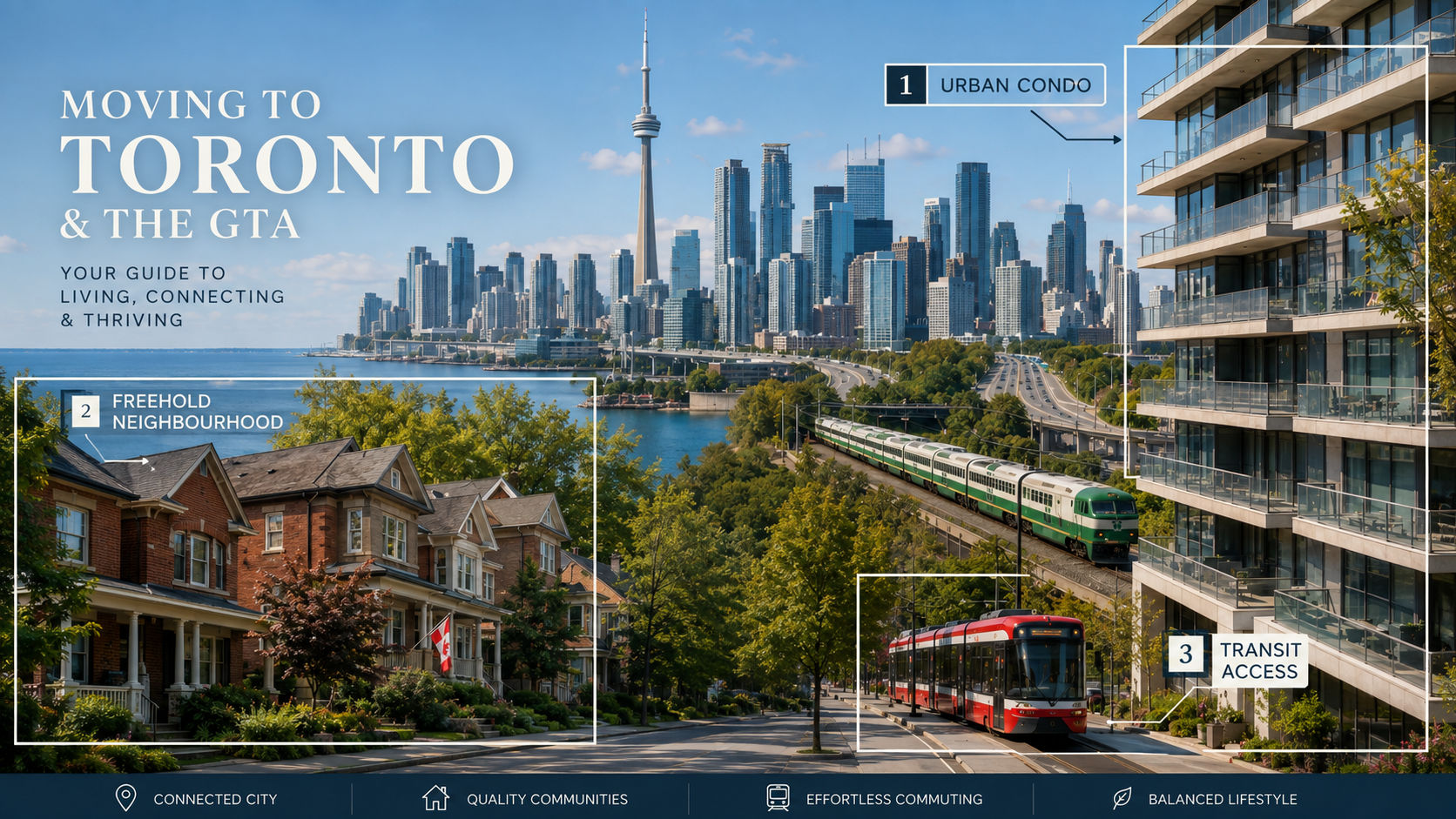
Toronto and the surrounding GTA contain very different housing types, transportation options and community settings. Someone who needs frequent subway access may make a very different decision from a household looking for a detached home, larger lot or easier access to employment in York Region.
Start by answering five questions:
- Where will you work, and how often will you commute?
- What monthly housing cost are you comfortable carrying?
- What type and size of property do you need?
- Are schools an important part of the decision?
- Which amenities and services will you use regularly?
Housing type should also be part of the location decision. The same budget may translate into a condominium in one part of the GTA and a freehold townhouse, semi-detached or detached home in another.
For a more detailed comparison of housing types and the buying process, see Buying a Home in Toronto and the GTA .
A downtown employee who commutes five days per week may place a premium on subway or GO access. Someone working in Richmond Hill, Markham or Vaughan may find that living farther north is more practical than commuting from Toronto.
A lower purchase price also does not necessarily mean a lower overall cost. Transportation, additional vehicles, parking and commuting time can materially change the calculation.
From my experience working with relocating buyers, I would usually narrow the search geographically before comparing individual properties. Finding an excellent home in the wrong location rarely solves the buyer’s underlying problem.
As MarcoMomeni.com’s individual community guides are published, this relocation guide should connect readers to detailed information about Richmond Hill, North York, Markham, Thornhill, Downtown Toronto, Midtown Toronto and Aurora/Newmarket .
2. Should I rent first or buy a home when moving to Toronto?
Renting first can be sensible when you do not yet understand the GTA or expect your employment, commute or housing requirements to change. Buying immediately can also make sense when your location, financing and longer-term plans are already clear.
The Government of Canada advises newcomers to consider both short-term and long-term housing requirements and notes that temporary housing may be useful while looking for a more permanent home.
Renting first may make sense if:
- you have not decided which municipality or neighbourhood suits you;
- your employment location may change;
- you are still establishing your finances in Canada;
- you want to experience the commute before committing;
- or you need more time to understand local housing types and neighbourhood differences.
Renting first does not mean everyone needs to wait a year before buying. The purpose is simply to reduce uncertainty before making a major long-term commitment.
Buying immediately may make sense if:
- your employment and income are established;
- mortgage financing has been reviewed;
- you have adequate funds for the down payment and closing costs;
- you already understand the communities you are considering;
- and you expect to remain in the area long enough for ownership to fit your plans.
The federal government also provides newcomer-specific guidance on preparing to buy, working with a real estate professional, financing, making an offer and obtaining mortgage insurance.
The wrong reason to rush into buying is simply the belief that paying rent is always “wasting money.” Purchasing the wrong property or choosing the wrong location can be far more expensive than renting temporarily while you learn the market.
3. Can I get a mortgage in Canada if I’m a newcomer or don’t have much Canadian credit history?
Possibly. Limited Canadian credit history does not automatically prevent a newcomer from obtaining mortgage financing. Qualification depends on factors including residency status, income, down payment, debts, creditworthiness and the requirements of the lender and mortgage insurer.
CMHC states that its newcomer mortgage-insurance offering is available to qualifying permanent and non-permanent residents. Where Canadian credit history is limited, CMHC may consider alternative methods of establishing creditworthiness.
That does not mean every newcomer will qualify, and lenders do not necessarily apply identical underwriting standards.
Before seriously shopping for a home, determine:
- whether you are currently eligible to purchase the property;
- how your creditworthiness will be evaluated;
- what employment and income documents will be required;
- how much down payment you have available;
- how much mortgage financing you may qualify for; and
- whether the resulting monthly payment is comfortable after your other expenses.
You can use the Marco Momeni Mortgage Affordability Calculator as an initial planning tool.
Important: Calculator results are general estimates only. Individual circumstances vary, and some buyers may qualify for more or less than the estimate. Mortgage qualification must be confirmed by a qualified lender or mortgage professional.
You can also contact Marco Momeni to discuss how a realistic purchasing budget translates into actual housing options across Toronto and the GTA.
4. How much does it really cost to live in Toronto or the GTA besides the price of the home?
Compare the total cost of the property and location—not just the purchase price.
Two properties with different purchase prices can become much closer in actual monthly cost once transportation, property expenses and condominium fees are included.
Depending on the property and location, consider:
- mortgage payments;
- property taxes;
- condominium maintenance fees, where applicable;
- home insurance;
- utilities;
- repairs and maintenance;
- transportation and transit;
- vehicle ownership;
- parking;
- and the cost of furnishing, renovating or improving the home.
There are also one-time purchase and closing costs.
Ontario imposes Land Transfer Tax on qualifying property purchases. Buyers purchasing within the City of Toronto can also be subject to Toronto’s separate Municipal Land Transfer Tax. Toronto changed its graduated MLTT rates for certain high-value residential properties effective April 1, 2026.
You can use the Marco Momeni Land Transfer Tax Calculator to estimate the applicable amount.
First-time buyers should check eligibility carefully
Ontario provides a Land Transfer Tax refund for qualifying first-time homebuyers. However, a buyer who has previously owned a home or an interest in a home anywhere in the world does not meet that particular first-time ownership requirement.
This can be especially important for newcomers who owned property before arriving in Canada.
For a fuller explanation of down payment requirements and closing costs, see Buying a Home in Toronto and the GTA .
Compare total monthly cost, not just purchase prices
Instead of simply comparing:
Property A: $900,000 versus Property B: $1,000,000
compare:
housing cost + property expenses + transportation + maintenance
and then ask what you receive in exchange for the difference in commute, space, neighbourhood and lifestyle.
That is a more useful relocation comparison.
5. How should I compare Toronto and GTA neighbourhoods before deciding where to live?
Evaluate a neighbourhood according to the life you will actually live there—not simply how it looks during a weekend property showing.
Test your real commute
Check the commute at the actual times you expect to travel.
The TTC provides a trip planner covering Toronto and the broader Greater Toronto and Hamilton Area, while GO Transit provides route and schedule planning for regional commuters.
If you expect to drive, do not rely only on the number of kilometres between your home and workplace. Travel times can vary substantially according to route and time of day.
A practical test is to check the trip during your expected morning and evening commute before making a purchase decision.
Verify schools using the exact property address
Do not assume that a property is assigned to a particular public school simply because the school is nearby or mentioned in a real-estate listing.
The Toronto District School Board provides an address-based tool for identifying schools serving a residential address.
York Region District School Board similarly provides an address-based school locator.
School boundaries, programs and eligibility can change. Buyers should verify the exact property address directly with the appropriate public or Catholic school board before relying on a school assignment when making a purchase.
Proximity to a school should never be treated as a guarantee of eligibility.
Look at the amenities you will actually use
Consider your weekly routine rather than a generic list of neighbourhood attractions.
Depending on your household, important factors may include:
- grocery stores;
- childcare;
- parks and recreation;
- healthcare;
- restaurants;
- cultural or religious institutions;
- public transit;
- highway access;
- shopping;
- walking or cycling options;
- and proximity to relatives or friends.
If possible, visit a neighbourhood at different times.
See it during the morning commute, after school, in the evening and on a weekend.
A community that feels convenient at 2 p.m. on Saturday may work very differently at 8 a.m. on Monday.
6. What should I know before moving to the GTA from another province or another country?
Do not assume that financing, purchase costs, housing types or even your legal eligibility to purchase will work exactly as they did where you previously lived.
Someone relocating from another Canadian province will face different questions from someone arriving in Canada for the first time, but both benefit from resolving financial and geographic issues before beginning serious property tours.
If you are relocating from another province
Pay particular attention to:
- Ontario closing and purchase costs;
- GTA commuting patterns;
- property taxes and municipal services;
- differences in housing stock;
- condominium versus freehold ownership;
- school-board boundaries;
- and how dramatically housing options can change by municipality.
Someone arriving from another city can easily underestimate how much location affects commute time and what type of property is available within a particular budget.
If you are new to Canada
There is another question to resolve before making an offer:
Are you currently legally permitted to purchase the property?
Canada’s federal prohibition on certain residential purchases by non-Canadians has been extended to January 1, 2027 . The legislation and regulations contain exceptions, so individual eligibility depends on the buyer’s circumstances.
A buyer should not assume that having temporary status automatically makes them either eligible or ineligible.
Obtain appropriate legal advice before signing an Agreement of Purchase and Sale if your status creates any uncertainty.
Foreign-buyer taxes can also be significant
Ontario currently applies a 25% Non-Resident Speculation Tax to certain residential property acquisitions by foreign entities and taxable trustees, subject to the applicable rules and exemptions.
Within the City of Toronto, a separate 10% Municipal Non-Resident Speculation Tax applies to certain purchases by foreign buyers, in addition to the Municipal Land Transfer Tax.
These rules can involve exemptions, definitions and individual circumstances that should not be simplified into a general online answer.
Anyone who may be affected should obtain advice from an appropriate real-estate lawyer, tax professional and mortgage professional before committing to a purchase.
A Better Way to Plan a Move to Toronto or the GTA
The biggest relocation mistake is often starting with individual listings.
A more useful sequence is:
Budget → work and commute → municipality → neighbourhood → housing type → individual property
Once those first decisions are clear, the GTA becomes considerably easier to navigate.
Marco Momeni has worked with buyers and homeowners across Toronto and the GTA for 24 years. If you are relocating and are unsure how your budget, commute and housing requirements fit together, Marco can help you compare the areas first and then narrow the property search.
About the Author
Marco Momeni, Broker, RE/MAX Hallmark Realty
Marco Momeni is a Toronto and GTA real estate broker with 24 years of experience and more than $1 billion in career real estate sales. With a civil engineering background, his approach to real estate decisions emphasizes property analysis, location, risk and long-term suitability rather than simply finding a property that fits a price range. Contact
MarcoMomeni.com 416.700.7070
This article provides general real-estate information and is not legal, tax, immigration or mortgage advice. Individual circumstances can materially change eligibility, tax treatment and financing. Obtain advice from the appropriate qualified professional where required.